
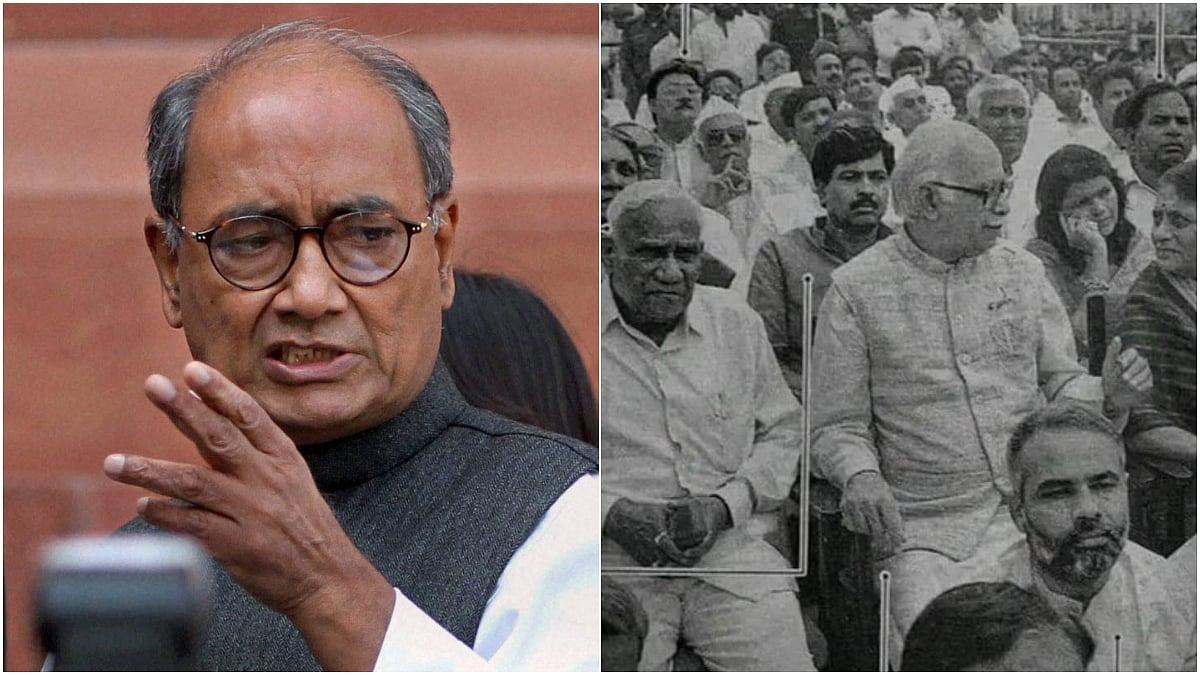
Senior Congress leader and Rajya Sabha MP Digvijaya Singh has set off a fresh political debate after publicly acknowledging the organisational strength of the Bharatiya Janata Party (BJP) and the Rashtriya Swayamsevak Sangh (RSS). His remarks, shared through a social media post, have surprised both supporters and critics, especially given his long-standing position as a key Congress strategist.
Singh posted an old photograph showing a young Narendra Modi seated on the floor near senior BJP leader L.K. Advani during a political event in Gujarat in the 1990s. Referring to the image, the veteran Congress leader highlighted what he described as the BJP–RSS culture of grooming grassroots workers and elevating them to the highest offices in the country.
In his post, Singh remarked that the image reflected the organisational discipline of the RSS and the BJP, where ordinary workers begin at the lowest level and, through years of dedication, rise to become chief ministers and even prime ministers. He described this journey as a demonstration of the “strength of the organisation,” adding a religious salutation that further intensified political reactions.
The photograph shared by Singh is believed to be from 1996, taken during the oath-taking ceremony of former Gujarat Chief Minister Shankersinh Vaghela. It later became part of a documentary chronicling Narendra Modi’s political rise in Gujarat.
What added to the intrigue was Singh tagging several top Congress leaders in the post, including party president Mallikarjun Kharge, Rahul Gandhi, Priyanka Gandhi Vadra, and senior leader Jairam Ramesh, along with Prime Minister Narendra Modi himself. The tagging was widely seen as deliberate and symbolic, fueling speculation about internal political messaging within the Congress.
The post has generated significant buzz as Digvijaya Singh’s current Rajya Sabha term is set to conclude next year. A seasoned politician, Singh has served as a Rajya Sabha MP since 2014 and earlier held the post of Madhya Pradesh Chief Minister for two consecutive terms between 1993 and 2003.
.jpg)
.jpg)


