
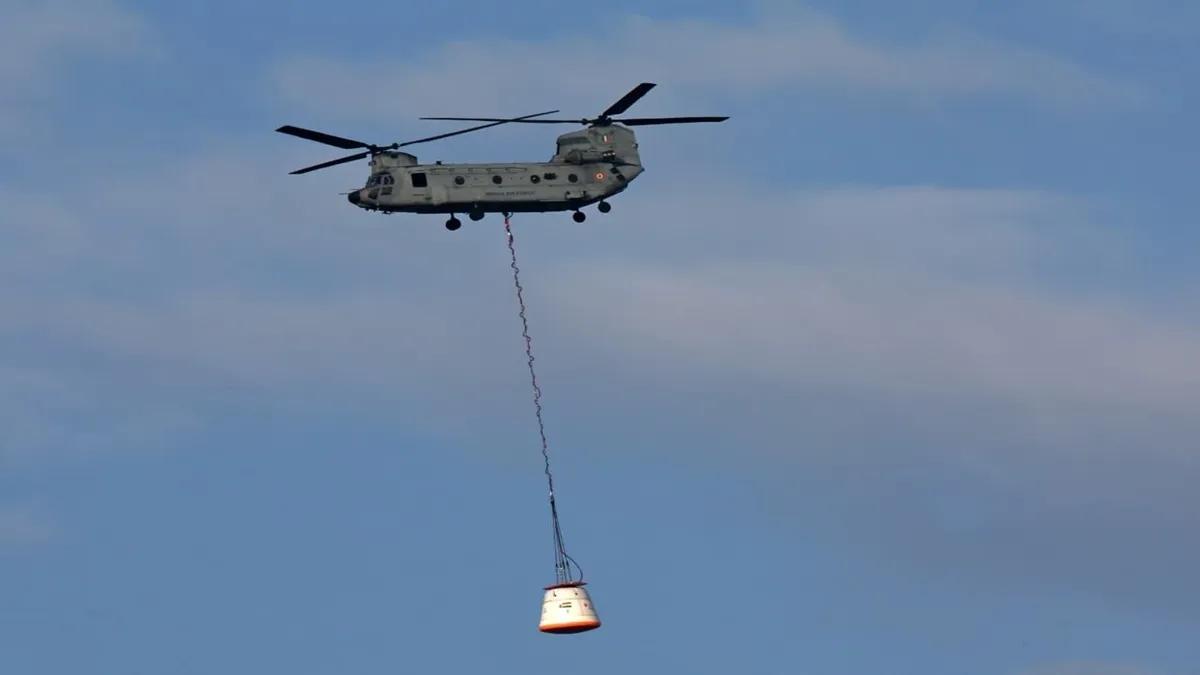
The Indian Space Research Organisation (ISRO) has successfully completed the first Integrated Air Drop Test (IADT-01) for its ambitious Gaganyaan programme, marking a crucial step toward India’s maiden human spaceflight. The trial, conducted on August 24 with support from the Indian Air Force, DRDO, Indian Navy, and the Indian Coast Guard, demonstrated the safe landing mechanism of the crew module.
In this test, a mock crew capsule was released from an aircraft and slowed down using a specially designed parachute system before landing smoothly. The demonstration confirmed that the system can safeguard astronauts during their return to Earth.
ISRO explained that the parachute sequence works in multiple stages—starting with the extraction process, followed by the release of drogue chutes, and finally, the deployment of the main parachutes. Each stage is vital to reduce the module’s velocity and guarantee a controlled touchdown.
Officials emphasized that the primary objective was to validate the functioning of the entire parachute deployment mechanism, which is critical for astronaut safety. The successful execution of IADT-01 boosts confidence in the mission’s safety design.
The Gaganyaan mission aims to send a three-member crew into a low Earth orbit, approximately 400 km above the planet, for a three-day mission. While an uncrewed demonstration is expected in December 2025, the first human spaceflight is being targeted for 2028. Achieving this milestone would make India the fourth nation to independently carry out human space missions.
ISRO has planned several more evaluations before the final launch, including advanced parachute trials, pad abort (emergency escape) tests, and sea recovery drills.

.jpg)

.jpg)


