
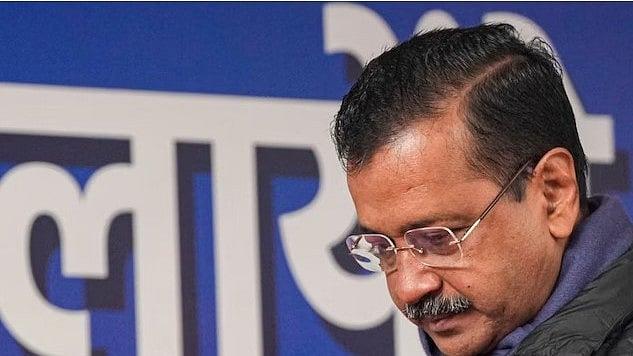
In the middle of a deep political crisis for the Aam Aadmi Party (AAP), party chief Arvind Kejriwal has made a dramatic move by writing to Justice Swarana Kanta Sharma, saying that he will neither appear before the court personally nor send a lawyer to represent him.
The letter came just hours after the Rajya Sabha Secretariat officially recognised the merger of seven AAP MPs with the BJP, a development that has badly weakened AAP’s strength in Parliament and created fresh doubts about the party’s future.
Political observers believe that Kejriwal’s letter is not just a legal step, but also an attempt to shift public attention away from the growing crisis inside his party and present himself once again as a leader fighting against the system.
In the letter, Kejriwal said his faith in getting justice from Justice Sharma had been broken and that he had decided to follow the path of “Satyagraha.”
By using the language of morality and conscience, Kejriwal is trying to show that his refusal to appear in court is based on principle rather than politics.
However, the timing of the letter has raised questions.
Just two days earlier, Raghav Chadha led seven out of AAP’s ten Rajya Sabha MPs into the BJP, giving the ruling party a major political advantage and dealing a heavy blow to AAP.
This mass exit was especially damaging because some of the leaders who left, including Raghav Chadha and Sandeep Pathak, were among the key faces behind AAP’s expansion, especially in Punjab.
Their departure has created the impression that AAP is losing both leadership strength and internal unity.
At such a moment, Kejriwal’s letter appears aimed at changing the public conversation.
Instead of allowing headlines to focus only on AAP’s internal collapse, the letter shifts attention to Kejriwal’s claim that he is being treated unfairly by the legal system.
This helps him return to the familiar image of being an “anti-establishment” leader fighting powerful forces.
The letter also refers to alleged links between the judge’s family and the Union government’s legal panels, which strengthens Kejriwal’s political message that the system is working against him.
This narrative may be especially important in Punjab, where AAP is in power and where elections are not far away.
With Punjab heading toward elections in less than a year, the loss of major Punjab-linked MPs has become a serious threat for the party.
Kejriwal appears to be using the language of “Satyagraha” to send a signal to party workers and voters that AAP is under attack from the Centre.
By doing this, he may be trying to stop further defections and protect the party’s support base in Punjab.
The move also helps Kejriwal prepare for any future legal setback.
By publicly saying that his trust in the court process is broken, he is laying the groundwork to argue that any adverse ruling against him is politically motivated.
This means that if the court rules against him later, his supporters may see it as part of political pressure rather than as a legal judgment.
In that way, the letter acts as a political shield.
At the same time, the letter is helping Kejriwal bring the party’s identity back around himself.
With several senior leaders leaving and the party structure under stress, AAP risks looking weak and directionless.
By making this a personal fight based on conscience and sacrifice, Kejriwal is trying to remind supporters of the movement-style politics that first made him popular during the anti-corruption movement.
This is a way of telling supporters that even if the party has weakened institutionally, its leader is still fighting.
Some analysts also believe the move has a legal advantage.
By refusing to appear in court, Kejriwal may delay legal proceedings and buy time for the party to stabilise itself politically.
This gives AAP space to manage internal damage in states like Punjab and Delhi, where the party’s organisational strength is now under pressure.
Overall, the letter seems to serve multiple purposes at once.
It creates a moral and political narrative, protects Kejriwal’s image, prepares the ground for future legal battles, and tries to hold the party together after one of the biggest setbacks in its history.
At a time when the BJP has gained momentum and AAP is battling a crisis of confidence, Kejriwal’s “Satyagraha letter” may be less about the courtroom and more about political survival.
.jpg)
.jpg)


